- FREE DELIVERY ON ORDERS OVER R1000
- Working Hours: Monday - Friday: 9am - 4:30pm

We don't currently stock , but our team can help.
Leave your details and we'll send you some options.
✓ Thanks! We'll be in touch with options shortly.
We don't currently stock , but our team can help.
Leave your details and we'll send you some options.
✓ Thanks! We'll be in touch with options shortly.
EXCELLENT Based on 403 reviews
 Posted on Google
 Eleni SiebertProduct quality is exceptional, service is excellent and turn-around time is amazing!! Thank you so much! I will definitely make use of your company again!!Posted on Google
 Kerry Wilson
Trustindex verifies that the original source of the review is Google.
Great to recive affordable samples that gave clear picture of colours and patternsPosted on Google Mike BoldingVery happy with wallpaper received.Posted on Google
 Katherine KirkbrideWe have used them for two separate projects and customer service on each project was extremely good.Posted on Google
 Wilmari Van HeerdenWhat an awsome experience, super efficient and great quality. Thank you !!Posted on Google
 Nikhil ParshotamSuper easy to order online. Quick delivery. Instructions on how to DIY. Happy customerPosted on Google
 Lesley BestExcellent service and product! A very user-friendly site and super effective communication. The whole process was a joy from start to finish!Posted on Google
 A - catI used the peel and stick wallpaper to cover some lasercut mdf boxes I had made. I really liked the paper texture (kozo?) and it was incredibly easy to work with and match patterns where I wrapped around the boxes. The order and delivery process was also good and quite fast (I received the paper before the boxes arrived from lasercutting people). I think I might need to tackle a wall to match my little boxes now :)Posted on Google
 Sam de JagerAwesome service. Quick and friendly.
from
R289.00 incl.
| SKU | Kruger-Treeline-Mural_Sage_Soft |
|---|---|
| Category | Forest Wall Murals |
| Manufactured | South Africa |
EXCELLENTBased on 403 reviewsPosted on GoogleEleni SiebertProduct quality is exceptional, service is excellent and turn-around time is amazing!! Thank you so much! I will definitely make use of your company again!!Posted on GoogleKerry WilsonGreat to recive affordable samples that gave clear picture of colours and patternsPosted on GoogleMike BoldingVery happy with wallpaper received.Posted on GoogleKatherine KirkbrideWe have used them for two separate projects and customer service on each project was extremely good.Posted on GoogleWilmari Van HeerdenWhat an awsome experience, super efficient and great quality. Thank you !!Posted on GoogleNikhil ParshotamSuper easy to order online. Quick delivery. Instructions on how to DIY. Happy customerPosted on GoogleLesley BestExcellent service and product! A very user-friendly site and super effective communication. The whole process was a joy from start to finish!Posted on GoogleA - catI used the peel and stick wallpaper to cover some lasercut mdf boxes I had made. I really liked the paper texture (kozo?) and it was incredibly easy to work with and match patterns where I wrapped around the boxes. The order and delivery process was also good and quite fast (I received the paper before the boxes arrived from lasercutting people). I think I might need to tackle a wall to match my little boxes now :)Posted on GoogleSam de JagerAwesome service. Quick and friendly.
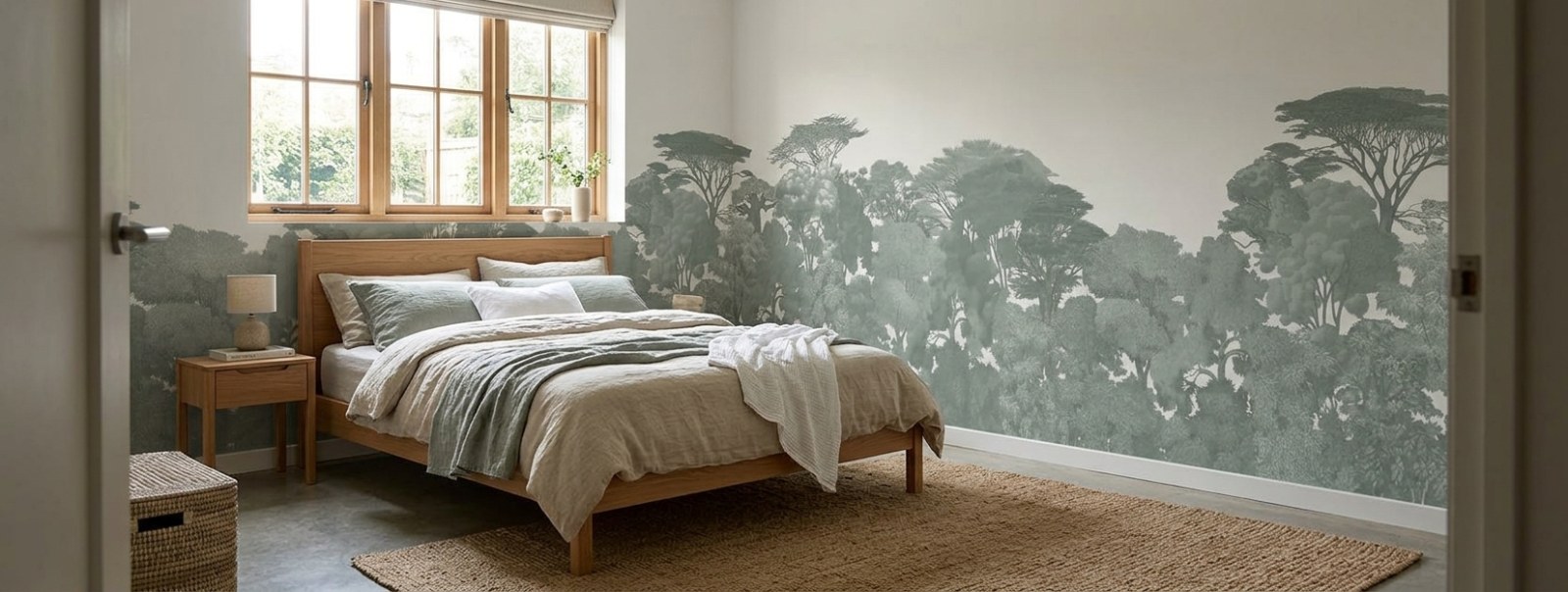
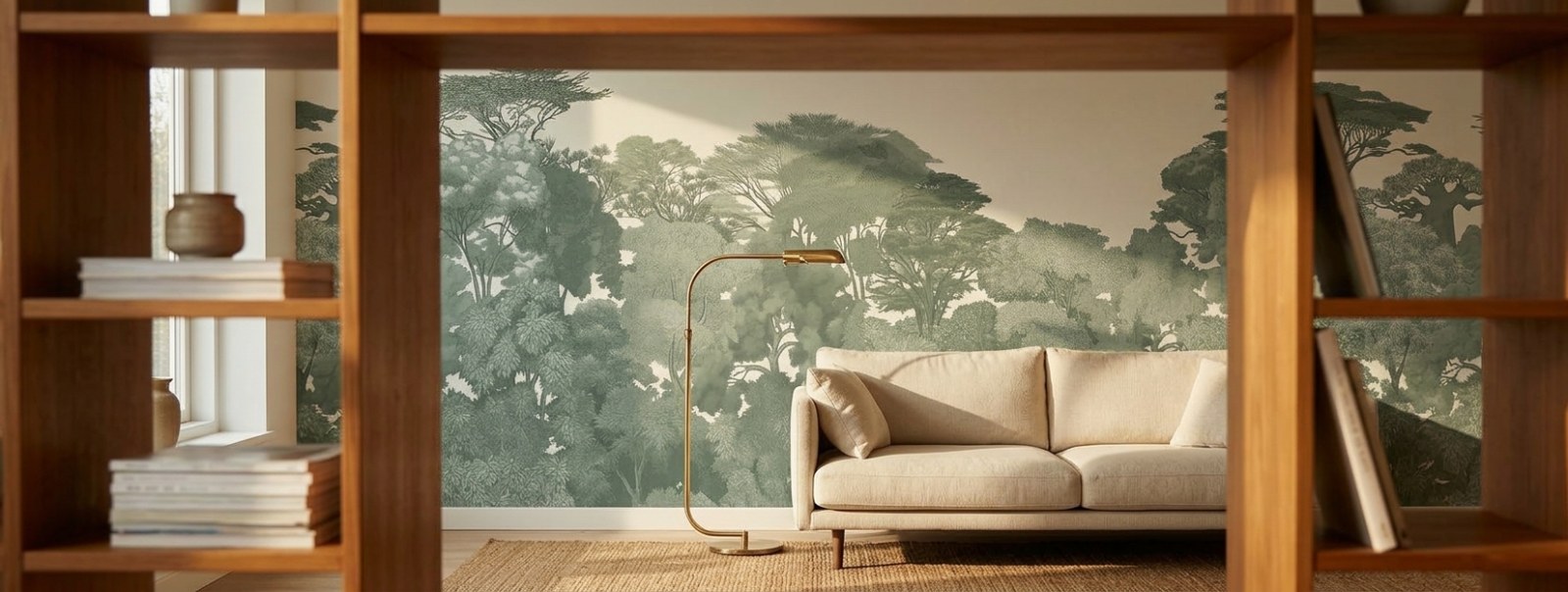
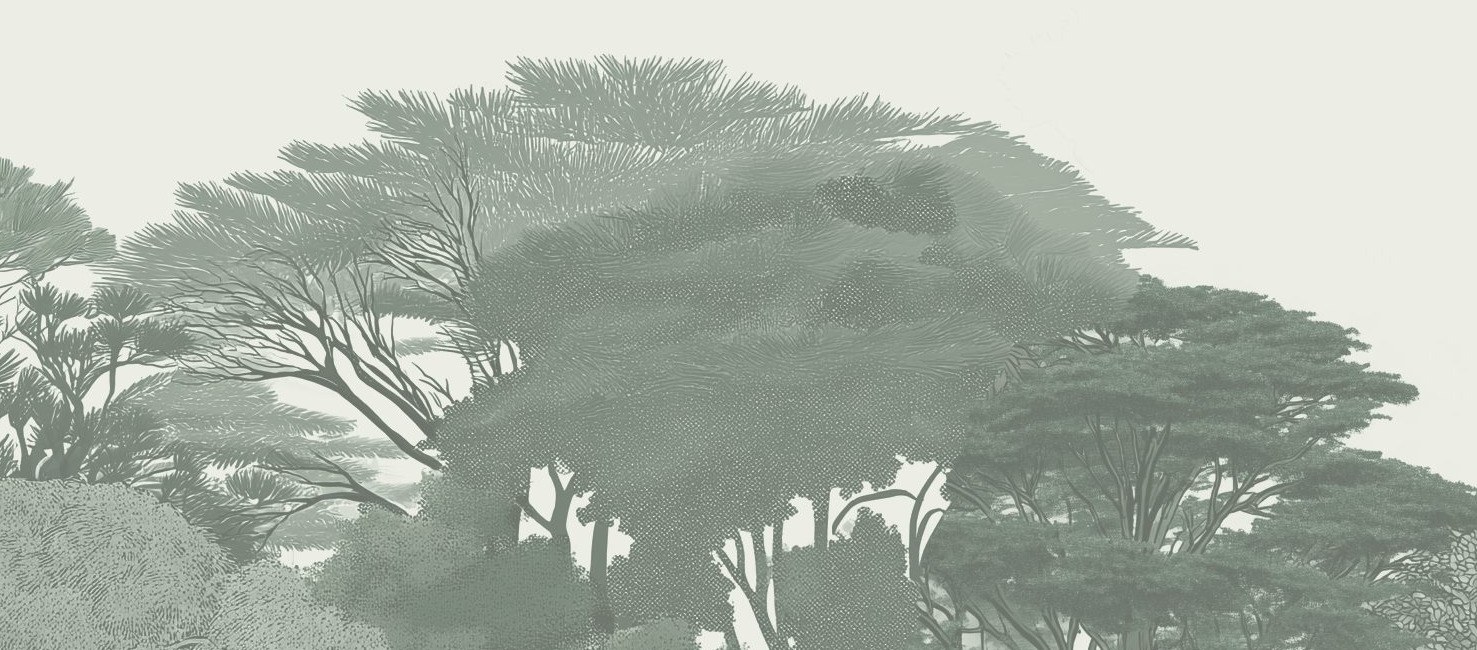
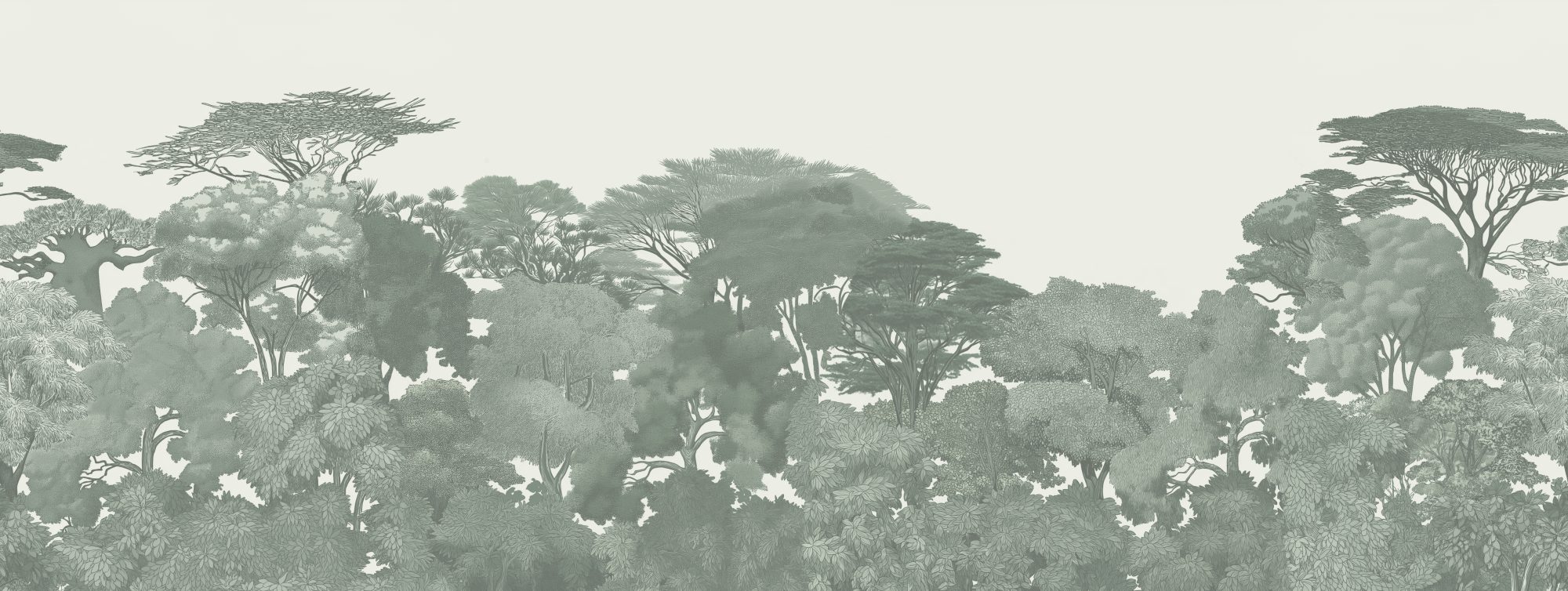
It's a continuous treeline drawn in fine linework, showing flat-topped acacia canopies, a thick-trunked tree resembling a baobab, and dense undergrowth along the base. The style is illustrative rather than photographic, so it reads as a quiet horizon scene rather than a detailed nature study, which keeps it easy to live with on a large wall.
The palette sits between sage green and olive, set against a pale cream ground. Greens are among the easiest colours to live with in rooms meant for rest, since they don't raise the room's energy the way reds or oranges do, while the cream sky keeps the overall effect open rather than enclosing.
The canopies are scaled to sit roughly a third to half of typical wall height, with taller trees breaking into the open sky above. From across a room the treeline reads clearly as a horizon rather than as fine texture, so it holds its own on a feature wall without needing to be viewed up close.
Because it's composed as one continuous scene, it needs enough distance for the eye to take in the whole treeline at once. A lounge, landing or bedroom wall where you can step back works better than a corridor you only pass through quickly, where the scene would never be seen whole.
Any furniture placed against the wall will cover part of the treeline, so it's worth deciding beforehand which section matters most, whether that's the taller acacia at either side or the denser cluster in the middle, and positioning the bed head or sofa back to leave that portion visible.
EXCELLENTBased on 403 reviewsPosted on GoogleEleni SiebertProduct quality is exceptional, service is excellent and turn-around time is amazing!! Thank you so much! I will definitely make use of your company again!!Posted on GoogleKerry WilsonGreat to recive affordable samples that gave clear picture of colours and patternsPosted on GoogleMike BoldingVery happy with wallpaper received.Posted on GoogleKatherine KirkbrideWe have used them for two separate projects and customer service on each project was extremely good.Posted on GoogleWilmari Van HeerdenWhat an awsome experience, super efficient and great quality. Thank you !!Posted on GoogleNikhil ParshotamSuper easy to order online. Quick delivery. Instructions on how to DIY. Happy customerPosted on GoogleLesley BestExcellent service and product! A very user-friendly site and super effective communication. The whole process was a joy from start to finish!Posted on GoogleA - catI used the peel and stick wallpaper to cover some lasercut mdf boxes I had made. I really liked the paper texture (kozo?) and it was incredibly easy to work with and match patterns where I wrapped around the boxes. The order and delivery process was also good and quite fast (I received the paper before the boxes arrived from lasercutting people). I think I might need to tackle a wall to match my little boxes now :)Posted on GoogleSam de JagerAwesome service. Quick and friendly.

Exclusive to Wallpaper Online the new ARTEX art canvas textured peel & stick gives artistic masterpiece energy to any space. -Commercial grade, textured PVC self adhesive wallpaper. -Waterproof & washable. -Repositionable & removable (DIY friendly).

- Commercial grade, textured PVC self adhesive wallpaper. -Waterproof & washable. - Repositionable & removable.
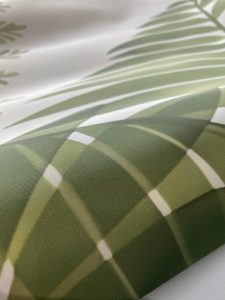
- Commercial grade fabric wallpaper. - Waterproof and washable. - Requires glue to apply.

- Soft touch smooth matte texture. - Peel & stick / self-adhesive wallpaper with backing paper (like a big sticker). - Waterproof & washable. -

- Traditional non-woven paper wallpaper. - Wipe-able but not waterproof or washable. - Requires glue to apply.
Enter the size of the wall you are covering in centimetres.
Please add 10 cm to both width and height for flexibility during installation.
Free room visualiser · 30 seconds · no sign-up
Get a 60 cm wide swatch of this design before ordering a full wall.
We recommend adding 10 cm to both width and height for trim flexibility.
Receive a 60 cm wide sample of this design printed on your selected material. Perfect for checking the colour, texture, and quality before ordering your full wall.
Don't worry about being exact — we produce custom sizes so you'll get a perfect fit!
We've saved the room photo you used earlier — try this design in it.
We'll render this design in your space — photo-realistic, at correct scale.
JPG, PNG, WebP up to 12 MB · Result ready in 6–12 seconds
We're composing your design at the correct scale. This usually takes 6–12 seconds.
You've used your 3 free renders today. Pop in your details to unlock 7 more renders across any design, and we'll send today's previews straight to your inbox.

Reviews
There are no reviews yet.